
Architecture Considerations for Running MES in Mission-Critical Manufacturing Environments
Picture this: A loss of network connection cuts off your Manufacturing Execution System (MES) and halts production at a high-volume automotive plant, delaying thousands of parts, scrambling schedules, and extending production timelines.
In today’s hyper-competitivelandscape, uptime is everything—and downtime is detrimental. No matter your industry or what you’re producing, a disruption on the factory floor can ripple across your supply chain, delay orders, and impact customer satisfaction. That’s why the architecture behind your MES matters.
At the heart of resilient operations is an MES platform built not only to scale but also to survive risks. In this article, we’ll explore the key architecture considerations for deploying an MES in mission-critical environments and how TrakSYS addresses those demands through high availability(HA), redundancy, and deployment flexibility.
Why Architecture Matters
MES sits at the convergence of IT and OT, connecting real-time shop floor data with enterprise systems. When architecting their solution, businesses can leverage high availability to ensure certain key facets of their MES deployment remain functional in the face of disruptions and unexpected network outages.
With the right architecture supporting your IT operations, you can ensure operational continuity, thus minimizing unexpected downtime.
TrakSYS and The Four Levels of MES Redundancy
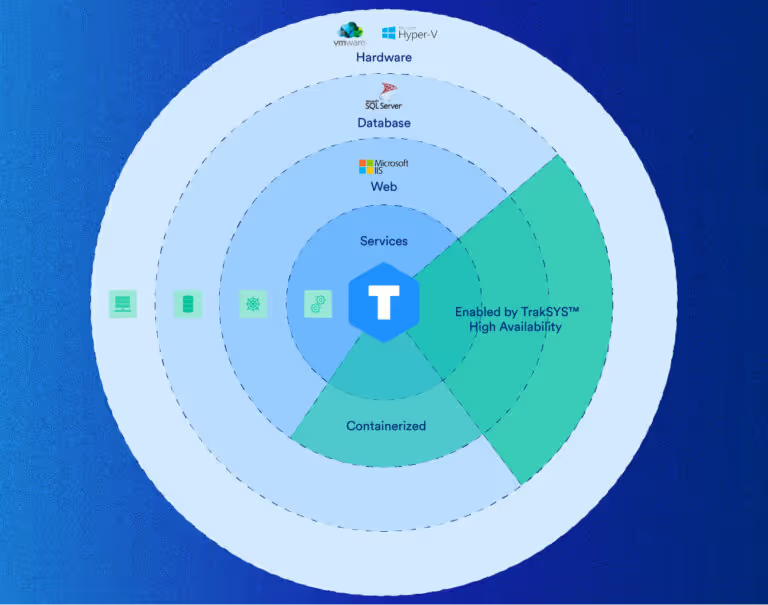
At Parsec, we believe in layered protection so your operations can stay agile and prepared for whatever disruption may come your way. As such, TrakSYS supports a comprehensive High Availability(HA) strategy that allows manufacturers to tailor levels of protection to their business needs and IT maturity.
The four layers of protection suggested in Parsec’s HA strategy include:
Modern Deployment: Containerized and Cloud-Ready
Beyond redundancies and IT safeguards, TrakSYS also supports containerized deployments using Docker and orchestration with Kubernetes. Containerization allows for:
- Elastic scaling of services across multiple nodes
- Rapid recovery using container orchestrators
- DevOps alignment with CI/CD pipelines
- Hybrid deployment modelswith choices of on-prem, cloud, or both
A containerized deployment is ideal for organizations aiming to standardize and scale MES across multiple facilities. It supports the TrakSYS Single Instance Multi-Site (SIMS) model and allows for future-proof deployment without reworking the architecture.
TrakSYS High Availability(HA) in Action
The platform’s ability to work with these industry-standard HA features helps ensure maximum system uptime and operational continuity, even in the event of hardware, software, or network failures.
Key benefits include:
- Automatic Failover: Monitors the health of core TrakSYS services (Web, Logic, Historian) across primary and standby nodes. If a failure occurs, the system automatically switches to a standby service to resume operations with minimal disruption.
- End-to-End Protection: Supports high availability for application and web services, databases, and infrastructure.
- Multi-Deployment Support: Works across all deployment types—on-prem, cloud, single-site, or multi-site/SIMS.
- Safer Updates: Enables precision updates with failover options, reducing risk during maintenance.
- Enterprise-Grade Resiliency: Aligns with IT best practices for mission-critical, 24/7 manufacturing environments, such as data replication, separation of roles, health checks, rolling updates, and more.
These features are best practices for manufacturers who cannot afford unplanned downtime, data loss, or security breaches. These standards help TrakSYS HA ensure operational continuity, data integrity, and compliance.
What does all of this mean for your TrakSYS deployment? The layers of redundancy look like this:
Conclusion
Implementing an MESin a mission-critical environment means thinking beyond features and focusing on resilience. With TrakSYS, manufacturers can deploy a system that’s not just functional, but fault-tolerant, flexible, and future-ready.
Whether you’re operating a single plant or managing a global network of factories, architecture is the silent partner in your digital transformation. When backed by the proper architecture, your MES will be there when your operations need it most.
Interested in leveraging high availability at your facility? Contact us today.
FAQs
Related Blog Posts







Let’s Build Your Plan
We’ll help you create the right configuration—today and for the future.