


TL;DR
Industrial process control systems use real-time feedback loops to monitor and automatically adjust critical variables. These controls create the foundation for smarter manufacturing by reducing fluctuations, improving quality, increasing throughput, and enhancing safety—especially when integrated with an MES.
Key takeaways:
- Feedback control drives stability: Closed-loop control systems continuously measure performance and correct deviations.
- Core components work together: Sensors, controllers (e.g., PLCs and DCS), HMIs, and final control elements form an integrated control architecture.
- Reduced variability improves performance: Stable processes lower scrap, boost first-pass yield (FPY), and enable higher throughput.
- Optimize safety and predictive maintenance: Automated alarms and condition monitoring reduce risk and unplanned downtime.
- MES integration amplifies value: Connecting process control with MES enables traceability, KPI monitoring, recipe management, and closed-loop quality.
How Controls Optimize Performance
Modern manufacturing depends on precision, consistency, and scalability. Yet production sometimes experiences unplanned downtime, inefficiencies, or quality variability—often stemming from uncontrolled or poorly tuned processes.
However. By continuously managing critical process variables such as temperature, flow rate, pressure, and chemical composition, industrial process control systems stabilize operations, reduce waste, and unlock measurable improvements in throughput, safety, and profitability.
Whether you’re evaluating your first control system or preparing to upgrade legacy infrastructure, this guide will help you understand what process controls are, how they work, and how to use them as a foundation for smarter manufacturing operations.
What is Industrial Process Control?
Industrial process control automatically monitors and adjusts variables to maintain optimal performance. Unlike basic automation, which follows a fixed sequence, process controls use feedback loops. These systems adapt in real-time to deviations and events, rather than simply reacting.
Industrial process control systems can support a range of operations, from single-loop controllers to sophisticated distributed control systems (DCS) orchestrating entire facilities. Regardless of the system, the goal is to maximize quality, minimize variability, and keep production on target with less manual intervention.
Core Components of Process Control Systems
Industrial process control systems combine field instrumentation with smart logic and actuation. Key components include:
- Sensors and transmitters convert process conditions into usable data.
- Controllers, such as DCS and PLCs, compare sensor inputs against target setpoints and compute adjustments using control algorithms.
- Human-machine interfaces (HMIs) provide operators with visibility and control.
- Integrations connect components, enabling fast, reliable communication with higher-level systems like Manufacturing Execution Systems (MES) and ERPs.
- Edge computing and IIoT devices capture real-time predictive insights and analytics for quick decision-making.
- Final control elements, such as valves, actuators, and motors, carry out adjustments.
Types of Industrial Process Control Systems
Different production processes require function-specific control strategies depending on how materials move through the environment. Types of control systems include:
In practice, many manufacturing environments use a combination of approaches. The most effective control architectures layer strategies to create predictable, high-performing operations.
The Key to Control Systems: The Control Loop
The control loop is the fundamental mechanism behind all process control; it’s a continuous cycle of measuring, comparing, calculating, and adjusting. Here’s how it works:
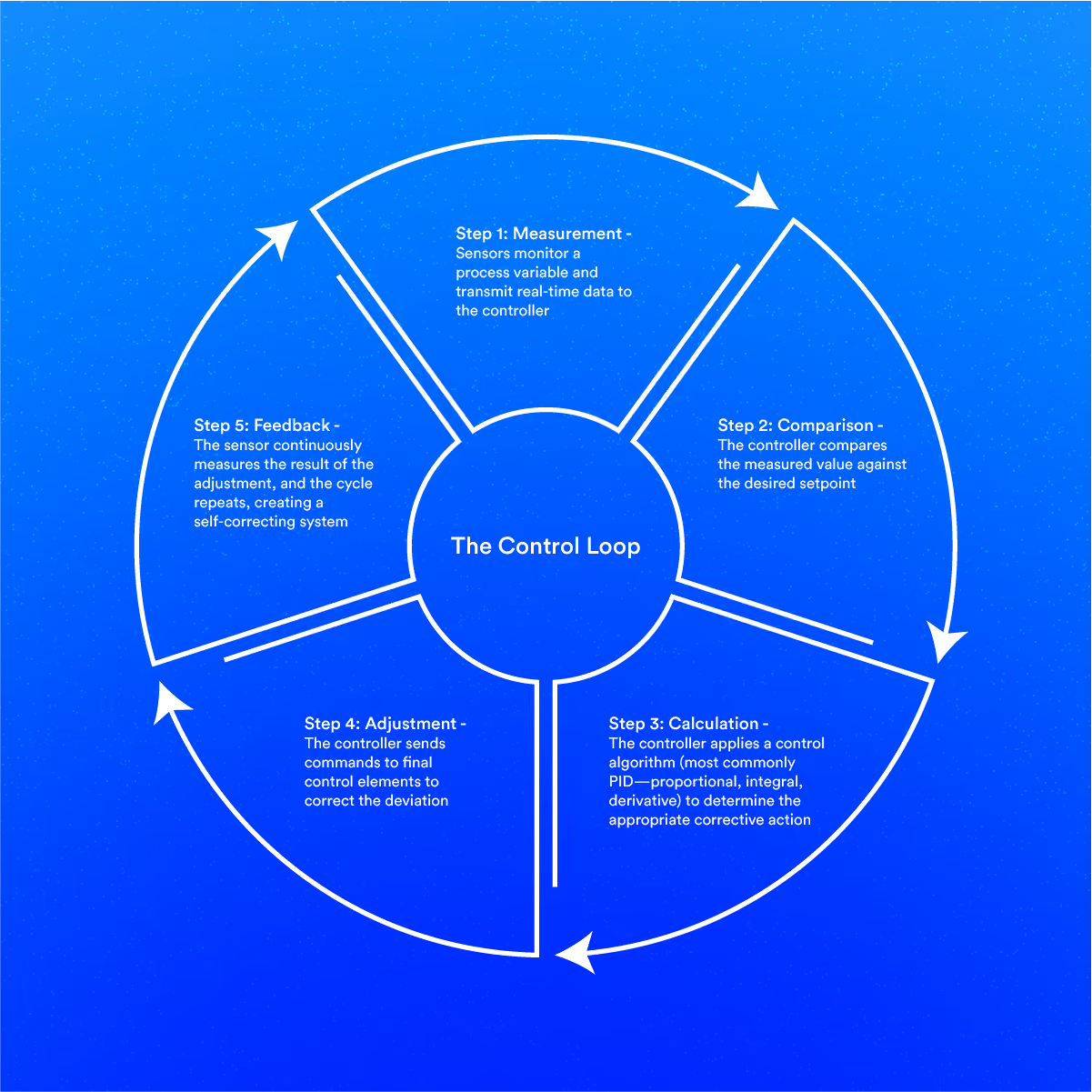
A well-tuned control loop is the key to stable, predictable performance.
With proper configuration, the loop reacts quickly to disturbances, such as fluctuations in raw material properties or environmental changes, while avoiding excessive overshoot or oscillation. Control loops bring processes back to a setpoint and maintain steady state operation with minimal variation. Poor tuning can cause the system to overcorrect, react slowly, or continuously circle around the target value.
Key Benefits of Industrial Process Control
At its core, internal process control is about stability. When critical parameters such as temperature, pressure, flow rate, or speed are maintained within narrow deviations, production quality becomes more consistent, variation decreases, and defect rates drop. In industries with strict regulatory oversight, this precision isn’t just advantageous—it’s essential.
Stability impacts waste and cost. When deviations are identified and corrected in real-time, manufacturers prevent scrap before it accumulates. Instead of finding quality issues at the end of a run, process control systems correct problems as they occur. Thus, reducing raw material waste, minimizing rework, and improving FPY.
Throughput gains follow naturally. Processes operating within controlled limits experience fewer upsets, emergencies, and downtimes, all while equipment runs closer to optimal capacity. Manufacturers can speed up production with confidence because the system continuously monitors and corrects performance.
Enhanced safety is another critical outcome. Automated shutdown logic, alarm management, and monitoring of hazardous conditions reduce reliance on human reaction time. In high-risk environments, process control systems protect personnel and facilities. Operators are alerted early to abnormal conditions, and safety procedures can intervene before thresholds are exceeded.
Finally, when integrated with condition monitoring systems, industrial process control supports predictive maintenance. Shifts in vibration, temperature, or performance can indicate equipment problems before failures. Manufacturers can schedule maintenance strategically, thereby reducing downtime, extending asset life, and improving reliability.
Together, these benefits compound. Better controls lead to overall better performance and optimized production, laying the groundwork for continuous improvement across the enterprise.
Common Applications
The benefits of industrial process control aren’t confined to a single sector or production model. Any operation that relies on repeatable, measurable, and stable conditions benefits from structured control. Industries differ, yet the same principles apply: measure accurately, compare against targets, and adjust in real-time to maintain stability.
Common use cases across industries include:
- Automotive: painting, welding, heat treating, and assembly operations to ensure consistent quality and throughput
- Food and Beverage: pasteurization, mixing, packaging, and CIP (clean-in-place) systems to ensure safety, consistency, and regulatory compliance
- Metals and Other Mining: smelting, rolling, heat treatment, and material handling to manage high temperatures and pressures while optimizing energy use
- Pharmaceutical: fermentation, crystallization, and environmental controls to meet strict GMP requirements and ensure product efficacy
- Power generation: fossil fuel, nuclear, and renewable energy use process controls for combustion management, turbine control, emissions monitoring, and grid synchronization
- Pulp and Paper Mills: wood chips digestion and control of paper machine speed, moisture content, and coating thickness
- Specialty Chemical: distillation, reactions, blending, and quality control to manage complex interactions between temperature, pressure, flow rates, and chemical composition
- Water treatment: manage pH levels, chemical dosing, flow rates, and treatment processes while meeting environmental discharge standards
Integrating Process Control with an MES
While process control manages the real-time execution layer, MES platforms like TrakSYS provide the operational intelligence to coordinate production across shifts, lines, and facilities.
TrakSYS can enhance process control by:
- Monitoring and adjusting production KPIs
- Enabling recipe control and parameter downloads
- Triggering quality workflows based on control performance
- Maintaining traceability across products, materials, and equipment
- Linking downtime events with process conditions and alarm states
This synergy between control systems and MES enables closed-loop quality management, smarter scheduling, and plantwide performance visibility.
Implementation Best Practices
Successful controls require both technical design and operational discipline. Implementing industrial process control is more than a tech upgrade—it’s an operational transformation involving engineering, IT, quality, and frontline teams. These best practices help ensure process control systems deliver measurable improvements:
- Start with a Process Audit
Before automating anything, identify which processes will benefit most from automated control, such as areas with high variability, frequent manual intervention, recurring quality issues, or energy inefficiencies. Prioritizing these high-impact processes ensures early wins and stronger ROI.
- Define Clear Objectives and Success Metrics
Establish measurable goals before implementation. For example, reduce temperature variation by 50%, decrease batch cycle time by 15%, or improve FPY to 97%. Clear metrics align stakeholders and create a benchmark for evaluating performance improvements.
- Ensure Adequate Instrumentation
Control systems can only manage what they can measure. Invest in accurate, reliable sensors appropriate for the operating environment (e.g., high heat or sanitary production areas). Poor instrumentation can undermine even the most advanced control strategy.
- Develop Robust SOPs
Define normal operating ranges, alarm response protocols, and clear criteria for manual overrides. Operators must understand when to trust automatic control versus when intervention is necessary.
- Implement Strong Cybersecurity Measures
As process control systems become increasingly connected, cybersecurity risk grows. Network segmentation, access controls, regular security updates, and collaboration with IT teams are essential to protect production environments from cyber threats.
- Provide Operator Training Beyond System Navigation
Train operators not just on how to use the interface, but on how control principles work. When operators understand feedback loops and system behavior, they are better equipped to recognize anomalies and support stable operations.
- Document Everything
Record control strategies, setpoints, tuning parameters, alarm thresholds, and configuration changes. Comprehensive documentation supports troubleshooting, compliance audits, and knowledge transfer—especially as experienced engineers retire or teams scale.
Conclusion
Smarter controls equal smarter manufacturing.
Process control isn’t just about automation—it’s about enabling higher productivity, better quality, and operational excellence at scale. Whether you’re stabilizing a single process or coordinating production across a global network, these systems lay the groundwork for sustainable, intelligent manufacturing.
When integrated with an MES platform like TrakSYS, manufacturers gain the agility and visibility needed to successfully implement effective control systems.
For more insights on how TrakSYS supports industrial process control, contact us today.
FAQs
Related Blog Posts
.avif)
.avif)
.avif)



Let’s Build Your Plan
We’ll help you create the right configuration—today and for the future.