


Bottlenecks in Manufacturing: How to Identify, Detect, and Eliminate Them
TL;DR
Manufacturing bottlenecks are unavoidable, but they don’t have to limit long-term performance. By identifying limitations early and using real-time production data to understand their root causes, manufacturers can improve throughput, reduce downtime, and continuously optimize operations, especially with the support of an MES.
Key takeaways:
- Bottlenecks occur when a single process step limits overall throughput, creating production delays, excess WIP, and higher operating costs.
- Detecting bottlenecks requires more than observation; it requires a combination of cycle time analysis, OEE, downtime tracking, and real-time production visibility.
- MES platforms like TrakSYS identify and contextualize bottlenecks by capturing machine states, production events, WIP, and performance data in real-time.
- Effective bottleneck management is an ongoing process that uses continuous monitoring and data-driven improvement to address shifting constraints across the operation.
To learn more about how real-time visibility optimizes production, contact us today.
Finding the Constraint Behind Lost Throughput
Bottlenecks occur when production gets “stuck,” with materials accumulating upstream while downstream equipment and operators wait idle. The resulting inefficiencies reduce throughput, increase costs, and complicate scheduling.
Detection is where things get tricky. Bottlenecks can build gradually over weeks or months, masked by overtime, expediting, and manual workarounds that treat symptoms rather than the root cause. This distinction is important because understanding where limitations exist, why they occur, and how they shift over time is fundamental to improving throughput and operational performance.
What Exactly is a Manufacturing Bottleneck?
A manufacturing bottleneck is a point of congestion in the production process where capacity is insufficient to meet demand, limiting overall throughput.
Every production system has at least one bottleneck at any given time; total output is always bound by its most constrained resource, regardless of how well other steps are performing.
Bottlenecks manifest in a variety of ways:
Beyond delayed shipments, active bottlenecks create secondary costs throughout the operation. Work-in-progress inventory grows, overtime increases, expediting becomes more frequent, and quality issues often emerge as teams attempt to compensate for lost capacity—all of which often go unattributed to their actual root causes.
How to Identify Bottlenecks in Manufacturing: Warning Signs and Signals
While bottlenecks will eventually affect deliveries and financial reports, their warning signs first emerge on the factory floor.
Work-in-progress (WIP) accumulation is often the first—and clearest—signal. When materials consistently queue in front of a workstation, it means inputs are arriving faster than they can be processed, thus creating a bottleneck. Such slowdowns can become normalized over time, making them prone to oversight.
Downstream idle time is another clue. Operators or equipment frequently waiting for supplies may be experiencing the effects of an upstream hindrance. The stagnant workstation itself is rarely the bottleneck; the source is usually a forerunning process step.
Cycle time analysis offers a more quantitative approach. Comparing actual cycle times against takt time requirements can uncover where production is failing to keep pace with demand. The largest and most persistent gap often reveals the issue.
Schedule attainment provides additional evidence. Chronic shortfalls against production plans, recurring batch splitting, constant reprioritization, and routine overtime may indicate a bottleneck.
These key indicators may seem straightforward, but the real challenge arises with timing. By the time these issues appear in end-of-shift reports, valuable production time has already been lost.
The Most Common Sources of Manufacturing Bottlenecks
While bottlenecks can emerge anywhere, several patterns appear repeatedly across manufacturing environments.
Equipment Capacity
Capacity limitations can develop when critical assets operate at or near maximum utilization, thus leaving minimal room for changeovers, maintenance, and demand fluctuations. Even minor disruptions to these assets can contribute to significant throughput losses.
Changeovers
Inefficient changeovers reduce capacity. Long setup times consume valuable production time and are a frequent—and often hidden—constraint in high-mix environments.
Unplanned Downtime
Unexpected halts to production have a substantial impact on a constrained workstation. For some machinery, a brief failure may have little effect, but the same event to a critical asset can ripple across the entire operation.
Labor Constraints
Specialized processes that require trained workers can become a throughput-limiting factor as schedules fluctuate and demand increases. The right equipment may be available, but without properly trained operators, assets sit idle.
Material Readiness
Material management frequently causes avoidable bottlenecks. Production orders may be ready to run, but materials remain unavailable due to inventory inaccuracies, receiving delays, or poor sequencing decisions.
Quality-Driven Rework
Rework loops are a particularly costly impediment, as defective products consume capacity twice: once during initial production and again during correction or reprocessing.
Bottleneck Detection Methods
Detection starts with direct observation—walking the factory floor, monitoring WIP accumulation, and speaking with operators. However. Observation alone rarely captures cross-shift trends or intermittent obstacles.
Cycle time analysis provides a more structured approach by comparing processing times across workstations. This method works well in stable environments with relatively predictable production patterns.
Value Stream Mapping (VSM) expands analysis by visualizing material and information flows across production processes. Bottlenecks often become apparent when viewed within the broader production system rather than as isolated workstations.
As operations become more dynamic, detection becomes more complex, and real-time production data becomes increasingly important. Manufacturing Execution Systems (MES) can be utilized to continuously capture production events, machine states, cycle times, downtime, and throughput metrics. This data enables manufacturers to evaluate constraints using up-to-date operational records.
MES platforms like TrakSYS feature capabilities that are particularly valuable for bottleneck detection:
- OEE dashboards segmented by asset, line, or production area
- Downtime reason trees linked to specific equipment states
- Production event timelines highlighting performance losses and interruptions
- Workstation cycle time tracking against planned production rates
- Real-time WIP visibility between process steps
These functions support dynamic bottleneck detection, allowing manufacturers to identify constraints as they appear rather than only after they have become persistent problems.
How to Eliminate Bottlenecks in Manufacturing
Effective bottleneck elimination depends on identifying the underlying cause and responding accordingly.
Not every root cause requires the same solution. Adding labor will not resolve a machine operating at full capacity, and purchasing new equipment may do little if the underlying issue is poor scheduling or recurring lapses in quality. Sustainable improvements come from accurately identifying the limiting factor, implementing targeted corrective actions, and measuring the results.
Bottleneck Management is Continuous
Alleviating a bottleneck rarely marks the end of the journey. Once one constraint is resolved, another resource becomes the new limiting factor. This migration is expected and reflects the natural behavior of production systems.
Successful manufacturers treat bottleneck management as a continuous cycle:
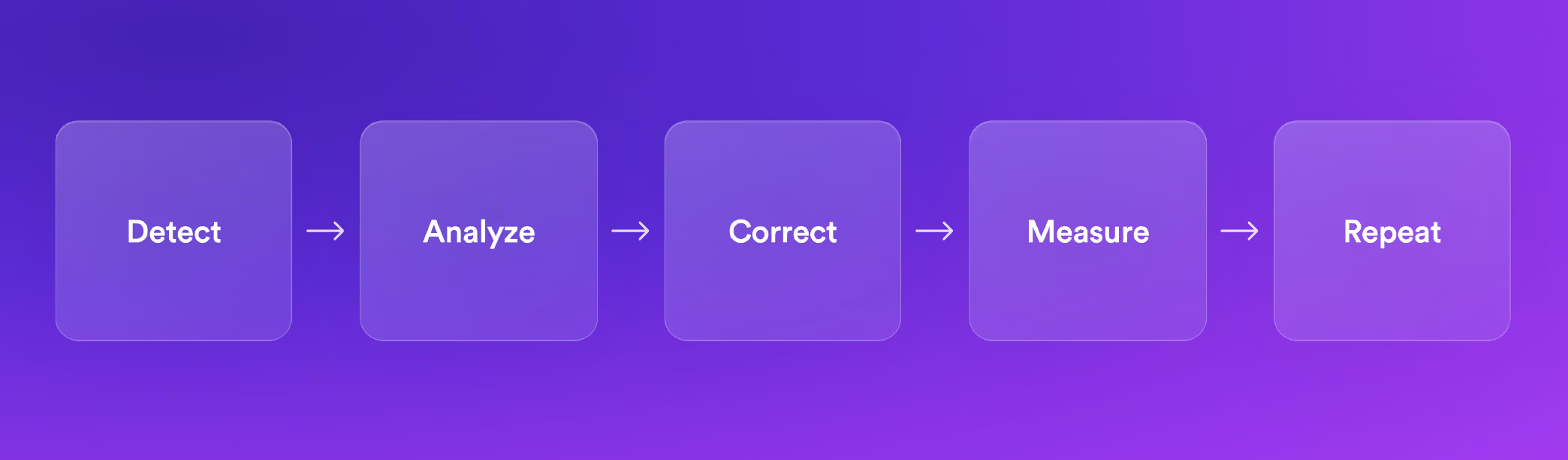
Each improvement effort should begin with a baseline. Capturing cycle times, OEE metrics, downtime frequency, and throughput before implementing changes creates the foundation for meaningful measurement afterward.
Cross-functional collaboration is equally important. Operations, maintenance, quality, scheduling, and engineering teams all influence bottleneck management. Sustainable improvements occur when these groups work from a shared understanding of production performance.
Real-time production visibility accelerates this process. Facilities equipped with live operational data can identify emerging constraints within hours, while facilities relying on daily reporting may require days or weeks to uncover the same issue.
Conclusion
Bottlenecks are an unavoidable part of manufacturing.
What separates high-performing operations is not the absence of constraints, but the ability to systematically detect, understand, and manage them.
Real-time production data provides the visibility required to move beyond reactive responses and toward continuous improvement. When equipment states, production events, downtime reasons, quality outcomes, and scheduling information are connected within a single operational view, bottlenecks become measurable, manageable, and simpler to eliminate.
Platforms like TrakSYS help manufacturers gain visibility, enabling continuous bottleneck detection and management across the entire operation.
To learn more about how real-time visibility optimizes production, contact us today.
FAQs
Related Blog Posts
.avif)
.avif)
.avif)




Let’s Build Your Plan
We’ll help you create the right configuration—today and for the future.