



TL;DR
AI will not replace your MES. It will replace the way you use it.
I hear the same question in almost every executive conversation this year: if AI can analyze anything, recommend anything, and even write software, why invest in a manufacturing execution system at all? It is a fair question. It is also the wrong one.
The right question: can AI turn the information in your MES from the raw material of periodic improvement projects into a continuously improving operating model?
Manufacturers who answer that question well will compound gains every shift. Manufacturers who skip the MES and bolt AI directly onto raw machine data will get impressive demos and very little that survives contact with the plant floor.
Why the Fear Is Reasonable, and Where It Breaks
The fear comes from a real shift. AI now writes code, summarizes documents, and answers questions that once needed an analyst. It is natural to ask whether a large execution platform is still worth the investment when point applications seem to appear on demand.
But the evidence from the broader enterprise market points the other way. MIT's Project NANDA reported in 2025 that roughly 95% of organizations saw no measurable return from their generative AI pilots. Its authors traced the failures to brittle workflows, weak contextual learning, and poor fit with daily operations, not to weak models.
Read that list again. Context, workflow, and fit with daily operations are exactly what an MES provides. AI fails where it has nothing to stand on. Manufacturing is the least forgiving place to learn that lesson, because a wrong answer does not just produce a bad slide. It produces scrap, downtime, or a recall.
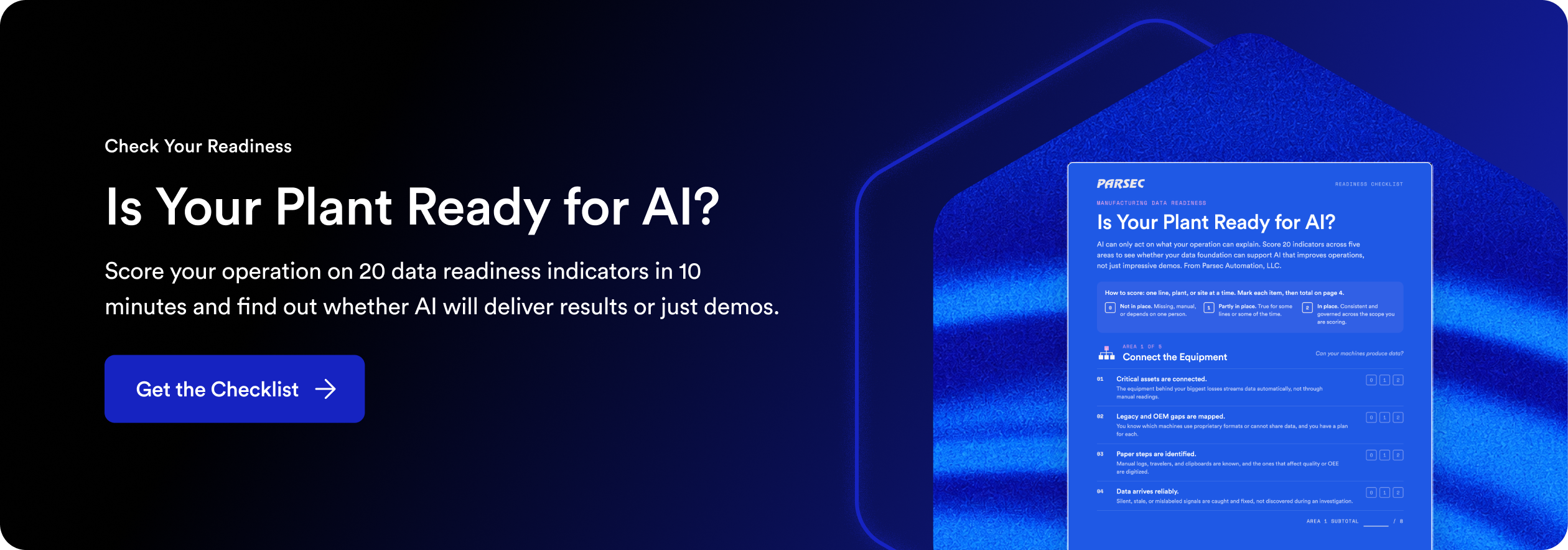
Before AI Can Understand the Plant, the Plant Has to Become Understandable
It is tempting to jump straight from raw machine data to AI insight. Real plants are messier than that. Most manufacturers run brownfield sites built up over decades, and the gap between "the machine produces data" and "AI understands what the data means" is where many AI initiatives quietly stall.
Greenfield and brownfield sites face this differently. New facilities can increasingly design the right architecture in from the beginning. Established plants have to build it incrementally, around equipment and systems accumulated over many years.
Walk through almost any established plant and you will find some version of the same picture:
- Legacy equipment that was never designed to share data, or shares it only on a local panel.
- Proprietary OEM systems that expose data in their own formats, if at all.
- Disconnected assets: manual stations, older lines, and paper-based checks that leave gaps in the record.
- Inconsistent naming and structures, so the same machine, product, or fault is called three different things on three lines or at three sites.
- Undocumented control logic that only one or two engineers understand.
- Incomplete information models, with no shared definition of states, reasons, or what counts as normal.
None of this goes away because AI arrives. It becomes more expensive to ignore. An experienced operator compensates for a mislabeled tag or a missing reason code because they know the line. An AI system cannot reliably or safely be expected to compensate for it, and the more authority it is given, the more damage a gap can do.
Making a plant understandable takes two kinds of work. The first is getting brownfield equipment to produce data at all: edge connectivity, protocol translation, and simple instrumentation for assets that were never connected. The second, and the one most often underestimated, is organizing that data so it means something: normalizing names, units, and structures; mapping each signal to the asset, process, and product it belongs to; and defining states, reasons, and limits consistently across lines and sites.
Standards help. Common equipment states, interfaces, naming conventions, and information models reduce the translation burden wherever they are adopted. But brownfield plants rarely have them everywhere, and where they do not exist, the normalization and contextualization still have to be done.
Connecting a plant makes data available. Organizing it makes data understandable. AI needs both.
AI can speed up this discovery work itself. Comparing the equipment listed in your asset tables against what is actually sending data quickly shows which machines are silent, which report under unexpected names, and where the record has gaps. What used to be a months-long audit becomes a focused list of what to connect and what to fix.
This is not a reason to wait. The work does not need to be finished across the enterprise before value starts. Start with one line or one major loss, make that operational picture trustworthy, and extend it. Each line that is connected and modeled well becomes the template for the next.
AI Needs Context. MES Is the Context Layer.
A temperature reading of 82.4 means nothing on its own. It becomes useful only when you know which asset produced it, which order and material were running, which batch it touched, which specification applied, who was on shift, and what happened just before and after.
A well-designed MES creates and maintains that web of relationships every shift. It is the difference between data and manufacturing information.
Table 1. The same events, with and without operational context. Examples are illustrative.
Tying values to assets and orders is the starting point, not the finish line. A trustworthy operational model, the kind AI can safely reason over and eventually act through, also captures:
Table 2. What a trustworthy operational model adds beyond raw data.
MES Is Also the Connection Layer to the Business
Context is half the story. The other half is reach. An insight that cannot reach the order, the schedule, the quality record, or the maintenance queue is just an observation.
MES is uniquely positioned between the business and the physical plant. ERP knows what was ordered and what it should cost. Control systems know what the machines are doing. The MES knows what should be produced, what actually happened, which materials and equipment were used, who did the work, and what exceptions followed. It is where a business decision becomes a production instruction, and where production reality flows back as a business record.
The Unified Namespace makes this stronger, not weaker. A UNS gives every system a common, event-driven view of the plant. But a namespace is a structure, not a meaning. The MES supplies the semantics that ride on it: states, reasons, genealogy, specifications, and the rules that say what counts as normal. AI working across a UNS with MES context can listen to the whole operation and understand what it is hearing.
It helps to be precise about what each layer of the stack actually delivers, because the terms are often used as if they were interchangeable:
- Connectivity. A system can reach the data.
- Interoperability. Systems can exchange it in a common format.
- Semantics. Everyone, and every system, agrees on what it means.
- Context. It is tied to the asset, state, order, and rules that make it actionable.
Being reachable on a network does not mean an AI system understands what a value means, whether it can be trusted, what operating state produced it, or what actions are permitted. Each step up that ladder is real work, and the top two are where the MES earns its place.
What AI Actually Adds: Speed from Signal to Action
AI does not change what good manufacturing looks like. It changes how fast you get there.
Most plants already generate enormous amounts of potentially useful information. The problem is that it is often incomplete, fragmented, inconsistently structured, or separated from the operational context needed to make it actionable. Even where the data is in good shape, plants lack the time and expertise to find the pattern, connect it to a cause, and decide what to do. That work sits with a small number of experienced engineers and moves at the pace of their calendars. AI compresses it:
- Pattern recognition at plant scale. Spot the recurring micro-stop, the shift-dependent yield loss, or the material lot that keeps preceding quality drift, across every line at once.
- Suggested next actions. Move from "what happened" to "here is what worked last time, and here is who should act."
- Best practices that travel. When one site solves a changeover problem, the approach becomes a recommendation for every similar line, instead of a story told at the next operations review.
- Answers in plain language. Supervisors and operators ask questions directly rather than waiting for a report to be built.
None of this works without the MES underneath. Pattern recognition needs coded reasons and genealogy. Suggestions need to know which actions are permitted. Best practices need a common model, so a lesson from one line means the same thing on another.
From Recommending to Acting, Through the MES
Today most manufacturers choose to keep a human in the loop, and they are right to. Over time, AI will take on more of the action itself: adjusting a parameter within approved limits, moving work to an available line, calling maintenance before a failure. That future is coming. The question is where those actions should run.
An AI agent that writes directly to equipment or to ERP, bypassing the execution system, can create actions without the necessary operational context, permissions, audit trail, or record of why. In any plant, that is a risk. In food, pharma, or medical devices, it is a non-starter.
Start with a firm boundary: AI does not override PLCs, control systems, or safety systems. Those deterministic layers keep doing exactly what they were designed to do. AI works above them, and earns more authority only inside explicit, tested, and governed limits.
AI should aide in making decisions faster, and the MES should remain the place where decisions become governed action.
The practical path runs in stages, and each plant moves at its own pace:
- Inform. AI explains what happened and why, with evidence from MES records.
- Recommend. AI proposes an action and shows the precedent behind it. A person decides.
- Act with approval. AI prepares the action inside the MES, such as a work order, a schedule change, or a parameter adjustment. A named person approves it.
- Act within guardrails. For well-understood, low-risk, reversible actions, AI acts on its own within limits the plant has defined. Every action is logged, explainable, and reversible.
Parsec's AI capabilities keep a person in the loop today, with a human approving every action before it takes effect.
Each step up is earned with evidence, not assumed. The MES is what makes the climb safe: it holds the limits, the roles, the approvals, and the record. That is why AI taking on execution makes the MES more essential, not less.
One of MES's Biggest Constraints Has Been Deployment Complexity
Here is something our industry rarely says out loud: when MES disappoints, missing functionality is seldom the main reason. More often, the project took too long, depended too heavily on a few expert individuals, and produced results that varied from site to site. Behind that sit familiar causes: incomplete discovery and requirements, excessive customization, weak standardization, complex integrations, inconsistent data, and change management.
That is a problem AI is well placed to address, and the work starts before anything is configured. Better discovery leads to better requirements, better requirements lead to better builds, and better builds make every later step, from insight to governed action, more reliable.
This is where Parsec has focused first. TrakSYS IQ Build, shipping and in use today, begins with discovery: it checks requirements and specifications for inconsistencies and gaps before anything is built. It then lets teams configure solutions through an AI-assisted interface, working from those requirements, proven solution patterns, function blocks, and templates. It does not start from a blank page. It starts from Parsec's decades of experience and proven best practices in how MES should be designed, configured, and rolled out.
The goal is not just faster configuration. It is better and more consistent configuration:
- Less unnecessary customization, which means easier upgrades later
- Closer adherence to proven patterns, across every implementation team and geography
- Documentation generated and kept current as the solution changes
- Expert knowledge embedded in the platform, so outcomes depend less on who happens to be assigned
When deployment gets faster, the economics of MES change. The first site pays back sooner, and the second, tenth, and fiftieth sites stop being new projects and start being repeatable rollouts.
From Improvement Projects to a Continuously Improving Operating Model
For most manufacturers, improvement still happens in bursts. A team pulls MES data, runs a kaizen or a Six Sigma project, fixes a problem, and moves on. Months later, the next project starts. The MES holds the evidence, but people do all the work of turning it into change.
AI changes that rhythm.
Table 3. Two models of continuous improvement.
This is the real prize. Not a smarter dashboard, and not an AI that replaces your systems, but an operation that gets measurably better every week because the loop from data to decision to action never stops turning.
That is also the right test for any AI investment. Manufacturers run MES to operate more efficiently, consistently, predictably, safely, compliantly, and profitably. AI should be judged against those outcomes, not by the number of agents, copilots, or demonstrations.
Questions to Ask Before You Buy
Whatever platform you evaluate, these questions separate AI that will work in your plant from AI that will stay in the demo:
- Where does the AI get its context? Is it reasoning over a governed operational model, or over raw tags and exported spreadsheets?
- Can it act, and through what? When AI recommends an action, does it execute through a system with permissions, approvals, and an audit trail?
- Who controls the autonomy dial? Can you decide, action by action, what requires human approval and what does not?
- What happens to your data? Can you restrict what AI can see by role and data area, and deploy in the cloud or on premises?
- Is it open? Can your own AI tools and third-party agents work with the system through standard interfaces such as the Model Context Protocol?
- How fast can you deploy the next site? AI should shorten your second rollout, not just your first demo.
- What happens when the AI is uncertain? How does it behave when data is incomplete, a source goes offline, or two sources disagree?
- What is in production today? Ask for live customer use, not roadmap slides.
The Decision in Front of You
The manufacturers who win the next decade will not be the ones who bought the most AI. They will be the ones who gave AI something trustworthy to work with, and a safe way to act.
That is what an MES is for. At Parsec, we are building TrakSYS to be the governed foundation that AI works through: the context it needs, the connection to the business it lacks, and the controls your operation requires. Waiting for AI to make MES obsolete means waiting on the sidelines while others compound their gains.
AI does not eliminate the architecture beneath manufacturing. It raises the value of getting that architecture right.
The more authority we give AI to act, the more trustworthy context, consistent semantics, governance, deterministic controls, and a strong execution layer matter.
The decision is not whether to choose MES or AI. It is whether to start building the operating model that lets them work together.
Sources
MIT Project NANDA, The GenAI Divide: State of AI in Business 2025 (preliminary report, July 2025), as reported by Virtualization Review, August 2025.
© 2026 Parsec Automation, LLC. TrakSYS is a trademark of Parsec. Capabilities and availability vary by TrakSYS version.
FAQs
Related Blog Posts



Let’s Build Your Plan
We’ll help you create the right configuration—today and for the future.