


How to Standardize Operations Across Multiple Manufacturing Plants

TL; DR
Standardizing operations across plants means that every site uses the same definitions, data structures, and core workflows, enabling accurate performance comparisons. This isn't uniformity, because plants can—and should—adapt to local workflows, as long as the results align with shared definitions. And versioned, governed templates keep standards from drifting as improvements scale across the enterprise.
Key takeaways:
- Multi-plant efforts stall when standards are stored in static documents, causing definitions to deviate and templates to multiply across sites.
- KPI and OEE definitions, reason codes, data models, and core quality workflows should be consistent across all facilities to ensure valid comparisons.
- Templates developed centrally and promoted in a controlled manner allow site improvements to merge back into the standard and drive continuous improvement.
- TrakSYS supports both single-instance and multi-instance deployments. The right approach depends on network reliability, the autonomy each plant requires, and regulatory and data-separation requirements.
Planning to standardize operations across multiple lines or sites? Contact us today.
Understanding Performance Across Plants
During a monthly operations review, several plants present their OEE, scrap, and downtime data. One plant in particular exhibits the strongest numbers, but someone raises the question—are they the highest performer? Or do they just measure differently?
Such questions are common. Parsec’s 2026 State of the Manufacturing Industry Report found that 23% of IT leaders describe their operations as having some digital tools, but little standardization. Scalability is where many digital transformation initiatives break down; an improvement that’s proven at one plant can only expand across the enterprise if definitions and processes are consistent.
Standardizing operations closes this gap. It starts with deciding which elements of production must match everywhere, which can adapt, and how changes are governed.
What Does it Mean to Standardize Operations Across Plants?
Standardizing operations across plants means every site uses the same definitions, data structures, and core workflows for measuring, recording, and improving production. This allows for straightforward performance comparison and simpler rollouts across lines and facilities.
What’s the Difference Between Standardization and Uniformity?
Standardization sets shared definitions and shared data management practices. It doesn’t require identical line operations. An enterprise’s bottling plant and blending plant can run different equipment while calculating OEE the same way and reporting downtime using the same reason-code structure, making results comparable. Meanwhile, uniformity is much more restrictive, asking every plant to run the same way in every detail, with matching equipment, layouts, workflows, and schedules, regardless of local constraints.
Why Do Many Multi-Plant Standardization Efforts Stall?
When standardization initiatives fail, it’s often because standards live in static documents rather than dynamic, digital systems. When each site configures its own version, and there is no controlled way to update standards, definitions eventually drift.
The solution is to build a gold-standard global template, with the expectation that every plant adopts it. This gives the entire network of facilities a single source of truth. However, each plant has its own unique products, equipment, and workforce, so templates can’t be entirely rigid.
Each of these barriers traces back to the same gap: standards have no owner and no controlled path for change.
What Should be Identical at Every Plant?
Manufacturers should standardize factors that are compared or governed, such as:
- KPI and OEE Definitions
Comparison needs identical equations: one definition of planned production time, one basis for ideal cycle time, and one set of stop thresholds. KPIs only produce comparable numbers when every site calculates them the same way. - Reason Codes
A shared top-level structure keeps enterprise roll-up clean. Tracing downtime from signal to reason code consistently across sites ensures each category means the same thing at each location. - Data Models, Tags, and Naming Conventions
Formalized equipment hierarchy and naming conventions keep data comparable across lines. Without consistency, data points multiply unevenly, and the same measurement can carry different names. - Quality and Compliance Workflows
Essential quality steps and approvals should behave the same at every plant, including how record changes are captured.
What Should Plants Be Allowed to Adjust?
As long as the results feed the shared definitions, plants can adjust line-specific workflows, work instructions, equipment integrations, language, shift patterns, and site-level improvement projects.
TrakSYS equips manufacturers with templates to deploy across regions while still giving sites local flexibility. Each facility can adjust UI to suit its operators, including screens, dashboards, and languages. The platform’s connected worker tools and equipment integrations can also be configured around each plant’s needs.
How Can Manufacturers Govern Changes to a Standard?
Treat standards like versioned products: develop and test changes centrally, promote them in a controlled process, and give sites a path to propose improvements that merge back into the core template.
A change starts in a central development environment, where it is tested against the shared definitions before any plant sees it. Versioned templates, built on the logic of branch and merge for MES development, let a tested change be promoted to a released version and deployed on a planned schedule. Governing MES templates at scale means every site knows which version it runs.
Site feedback then closes the loop. A plant that finds a better way to handle a changeover proposes it, and any approved revisions are merged back into the standardized template. This allows plant execution to stay local while oversight stays central.
Single-Instance vs Multi-Instance Deployment
Single-instance multi-site solutions, or SIMS, run every plant on one shared instance for maximum consistency. Multi-instance solutions deploy a separate instance at every site, each with its own governance. The right choice depends on network reliability, how much autonomy each plant needs, and regulatory and data separation needs.
With TrakSYS, both architectures are possible.
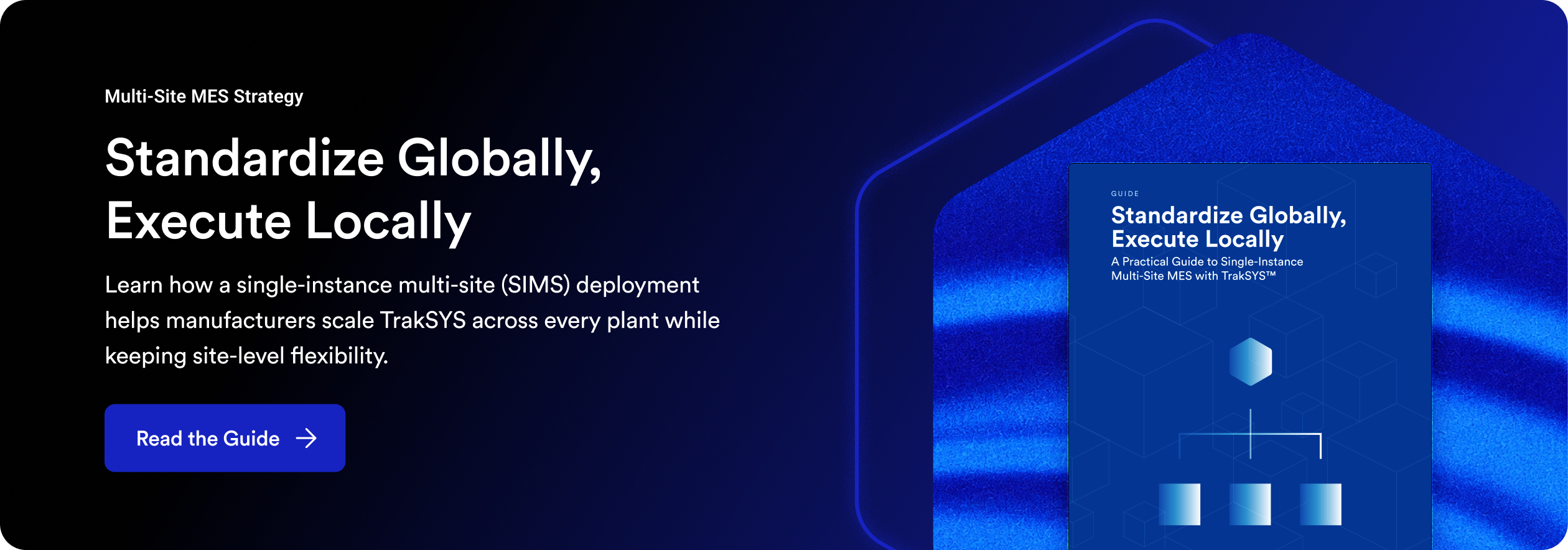
SIMS suits networks with reliable connectivity and a goal of one configuration and data model everywhere. Multi-instance fits sites that need to run locally or stay physically separate, with consistency maintained through template governance.
How Can Manufacturers Roll Out Standards Across Plants Without Disrupting Production?
Incremental rollout can minimize disruption. This is achieved by proving the standard on a single line or plant, turning it into a template, then sharing it with other locations alongside a repeatable playbook.
TrakSYS Implementation Example
TrakSYS customer Corticeira Amorim needed a system that could optimize production across multiple facilities while adapting to each site’s needs. Previously, their plants had limited shop-floor visibility, little insight into actual inventory levels, and relied on paper records that were manually entered into their ERP system days or weeks later.
They piloted TrakSYS at one Champagne cork stopper facility before rolling it out across 25 global production sites. After implementation, operators could monitor material consumption in real-time and batch and recipe management were directly connected to their ERP, thereby reducing manual entry errors. As a result, Corticeira Amorim saved over €26 million by optimizing inventory levels, improved OEE by up to 10 points, eliminated paper from the factory floor, and established end-to-end traceability across facilities.
Conclusion
Plants that scale improvements effectively start with shared definitions and standard templates. Deciding what must match, what can adapt, and how changes are governed transforms best practices into dynamic standards that drive continuous improvement.
An MES manages standardization and reduces plant drift by housing OEE definitions, KPI calculations, reason codes, and data models. With TrakSYS, versioned templates keep changes controlled and visible, while local configuration leaves room for each site’s unique needs, resulting in accurate data comparison and rollup from line to plant to enterprise.
Planning to standardize operations across multiple lines or sites? Contact us today.
FAQs
Related Blog Posts




Let’s Build Your Plan
We’ll help you create the right configuration—today and for the future.