


MES Software That Unifies Your Manufacturing and Empowers Your Teams
A manufacturing execution system (MES) is software that captures, contextualizes, and controls real-time production data to improve visibility, traceability, and operational performance on the shop floor. TrakSYS is the MES software designed for manufacturers who want more than visibility: clarity, agility, and control.
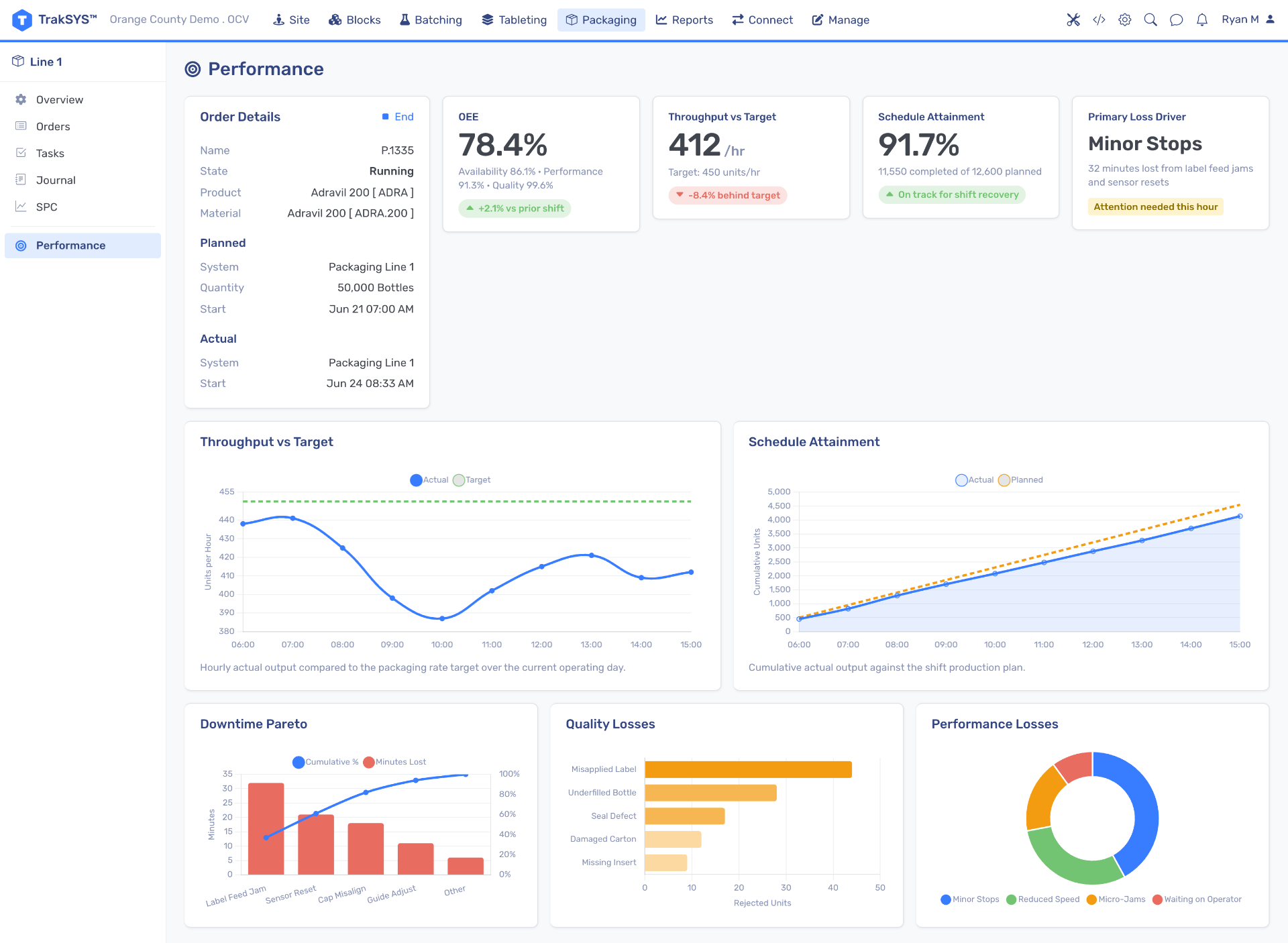
What Is a Manufacturing Execution System (MES)



TrakSYS: An MES Built for Complex Manufacturing
TrakSYS: An MES Built for Complex Manufacturing
A guided tour of the MES platform built to fit your operation's actual workflows. See how TrakSYS gathers and monitors the data you need, and how it stays flexible enough to meet batch, discrete, and continuous operations where they are, whatever the industry.
What Is MES, and How Is It Different From ERP and PLM?
MES Built Around Your Industry
TrakSYS adapts to the standards, workflows, and pressures specific to your sector.
Life Sciences
Support GMP compliance, batch integrity, and full traceability in regulated pharma and biotech environments.
Food & Beverage
Ensure product quality, traceability, and uptime in high-speed, high-volume environments.
Automotive
Track part-level production, enforce quality standards, and support high-mix, just-in-time assembly.
Consumer Packaged Goods
Drive efficiency, reduce waste, and increase visibility across daily packaging and production lines.
Specialty Chemicals
Control complex process formulation, batch execution, and regulatory compliance.
Industrial Manufacturing
Unify operations across discrete and process workflows with flexible, site-adaptable MES tools.
Core MES Capabilities
Real-time Data Collection
Capture machine, operator, and process data as it happens, with no manual entry delay.
Production Scheduling
Sequence, dispatch, and adjust work orders as conditions change on the floor.
Work Order Management
Track every work order from release to completion, with full visibility into status and exceptions.
Traceability and Recall
Trace materials, genealogy, and process history down to the batch or unit level.
Regulatory Compliance
Meet GMP, FDA, and other regulatory requirements with built-in audit trails and electronic records.
Preventive Maintenance
Reduce unplanned downtime with maintenance schedules driven by real equipment condition.
What Customers Say
Standards and Regulations MES Helps You Meet
Related MES Content
FAQs
A manufacturing execution system (MES) is software that connects, monitors, and controls production on the shop floor in real time. It acts as the operational bridge between business planning systems like ERP and the physical manufacturing process, aggregating data to give teams visibility, traceability, and actionable insight into what's actually happening on the floor.
An MES improves visibility into production performance, reduces manual data entry, strengthens traceability for compliance and recalls, supports consistent quality enforcement, and helps reduce downtime and waste. It also connects previously siloed systems, so planning and shop-floor data stay aligned.
Most MES rollouts start with a single line or site to validate configuration and prove value, then expand site by site using a standardized template. A single-site deployment can typically go live in a few months; a full enterprise rollout takes longer, since it also means aligning site-level execution with broader goals like quality, maintenance, and supply chain.
ERP manages enterprise-wide planning, including finance, procurement, and inventory. MES manages real-time execution on the shop floor, including production scheduling, machine data capture, traceability, and quality enforcement. The two are complementary, not competing. ERP tells the floor what to make, and MES tracks how it got made, with the two systems integrated to keep planning and execution aligned.
Yes. TrakSYS is built for native interoperability with ERP systems, SCADA, historians, and plant floor equipment across common industrial protocols, so it fits into an existing technology stack rather than replacing it.
MES and MOM are related but not identical. MES is the technology that executes and manages shop-floor operations. MOM is the broader strategic framework, covering production, quality, maintenance, and inventory and supply chain management, that MES helps enable. Per ISA-95, MES operates at Level 3 of the automation hierarchy, between Level 2 SCADA/PLCs and Level 4 ERP systems. TrakSYS delivers MES functionality while supporting MOM-level practices across those broader operational domains.